I am the A. Doak Barnett Professor of China Studies at Johns Hopkins School of Advanced International Studies (SAIS). I study China, climate change, cities, and statistics. I serve as an editor at Good Authority and write the China Lab newsletter. You can find my CV here.
My principal research and next book project currently focuses on the political economy of China’s decarbonization. In October 2025, Heatmap published my thoughts on China’s unambitious climate targets and what they might portend for our global future. In May 2025, I wrote about China’s energy megabases for the Wire China and laid out my ideas for real climate realism in Heatmap. In April 2025, Foreign Policy published “Tariffs Can’t Stop China’s Clean Energy From Winning the Future,” an essay with my SAIS colleague Jonas Nahm.
Phenomenal World ran my analysis of China’s Carbon Triangle, investigating the carbon implications of its growth model focused on land, finance, and real estate. For 2023-2024, the Wilson China Fellowship supported this research and a more academic piece “China’s Carbon Triangle: Climate Change and the Unwinding of the Land-Finance-Real Estate Development Model.” I lectured on the Political Economy of Greening China in 2023 for Cornell University’s Atkinson Center.
The climate site Heatmap has published a few of my essays, including “More Clean Energy Is Good, Even If It Comes From China,” “China’s Old Economic Model Is Breaking. Its Replacement Might Be Green,” and “China’s Solar Boom Is Big, Fast, and Unstable.” Columbia’s Center on Global Energy Policy published a commentary that I wrote (with Edmund Downie) in 2021 on how provinces are adapting to China’s national decarbonization pledges. Finally, a research article (joint with Victoria Liu) is in Environmental Research Communications, “What’s Not Trending on Weibo: China’s Missing Climate Change Discourse,” that … does what it says on the tin.
One piece of this project covers the role of authoritarianism in climate politics. The Journal of Democracy published my essay with Nomi Claire Lazar, “Resisting the Authoritarian Temptation,” as part of a forum with comments and our reply. An earlier essay on Political Science, Authoritarianism, and Climate Change may also be a good place to start.
I’ve had the privilege to appear on podcasts to talk about this research as well. Richard Delevan had me on Wicked Problems to talk in November 2024 and again in May 2025. Rob Meyer and Jesse Jenkins of Shift Key invited me to join in November 2024.
Many of my China Lab and Good Authority posts also explore these spaces. Much more to come.
For Foreign Policy, I reviewed Dan Wang’s Breakneck and wrote about how we know what we know about China back in November 2024.
In my most recent book Seeking Truth and Hiding Facts: Information, Ideology, and Authoritarianism in China, I argue that a few numbers came to define Chinese politics, until they did not count what mattered and what they counted did not measure up.

CSIS hosted a virtual book launch that can be viewed here.
I’ve written a number popular pieces related to the book and its themes.
- Why Does China Remain Locked On Growth Targets?
- Is China Losing GDP Religion?
- Xi’s First Steps in Power Signaled His Political Turn
- Interview: Jeremy Wallace on The Chinese State’s “Limited, Quantified Vision”
- Why protesters are targeting Xi Jinping for China’s ‘zero covid’ failures
- Why China Aims Too High
I was also happy that Foreign Affairs chose my essay with Henry Farrell and Abe Newman, Spirals of Delusion, on how AI distorts decision-making and makes dictators more dangerous, as one of its Best of 2022.
In 2021, my research on COVID-19 was published in APSR (with Michael Neblo) and on China’s relationship with the international order in International Organization (with Jessica Chen Weiss).
I’ve written about the politics of statistics in the COVID pandemic at the Washington Post, LA Times, and Foreign Policy. I wrote about the anti-zero COVID protest movement and the policy’s abrupt end for the Monkey Cage. Following the Shanghai lockdown, I argued that China’s zero COVID policy has been a catastrophic success that mirrors the country’s GDP-centric economic governance. Previously, the Washington Post’s Monkey Cage blog published my thoughts on Xi Jinping’s “common prosperity” slogan, his increasingly personal rule, China admitting that its statistics are unreliable, and the political implications of China’s 2015 stock market crisis.
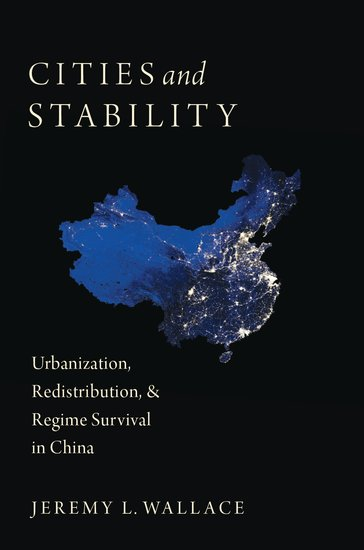
My first book, Cities and Stability: Urbanization, Redistribution, and Regime Survival in China, explores the interplay of China’s management of internal migration, urbanization, and redistributive policy as well as cross-national patterns of authoritarian regime survival and urban protests. I also led a collaborative project on China’s Cities, funded by Cornell’s Center for the Social Sciences.
From 2015 to 2024, I was a faculty member in Government at Cornell University. I spent 2021-22 on sabbatical leave at Georgetown’s Mortara Center for International Studies. I used to host the China Lab podcast and blogged occasionally at Science of Politics.

 Jeremy Wallace